CAIN Web Service
A Chronology of the Conflict - 1969
[CAIN_Home]
[Key_Events]
[Key_Issues]
[CONFLICT_BACKGROUND]
BACKGROUND:
[Acronyms]
[Glossary]
[NI Society]
[Articles]
[CHRONOLOGIES]
[People]
[Organisations]
[CAIN_Bibliography]
[Other_Bibliographies]
[Research]
[Photographs]
[Symbols]
[Murals]
[Posters]
[Maps]
[Internet]
Text and Research: Martin Melaugh [last update: 7 May 2021]
Material is added to this site on a regular basis - information on this page may change
The following is a draft chronology of the conflict for the year 1969
1969 Jan Feb Mar Apr May Jun Jul Aug Sep Oct Nov Dec
Sources Notes
1969
January 1969
Wednesday 1 January 1969
People's Democracy March Began
 Approximately 40 members of People's Democracy (PD) began a four-day march from Belfast across Northern Ireland to Derry. The Northern Ireland Civil Rights Association (NICRA) and some nationalists in Derry had advised against the march. The march was modelled on Martin Luther King's Selma to Montgomery march. The first day involved a walk from Belfast to Antrim. [Over the next four days the number of people on the march grew to a few hundred. The march was confronted and attacked by Loyalist crowds on a number of occasions the most serious attack occurring on 4 January 1969.] Approximately 40 members of People's Democracy (PD) began a four-day march from Belfast across Northern Ireland to Derry. The Northern Ireland Civil Rights Association (NICRA) and some nationalists in Derry had advised against the march. The march was modelled on Martin Luther King's Selma to Montgomery march. The first day involved a walk from Belfast to Antrim. [Over the next four days the number of people on the march grew to a few hundred. The march was confronted and attacked by Loyalist crowds on a number of occasions the most serious attack occurring on 4 January 1969.]
Thursday 2 January 1969
The People's Democracy (PD) march continued, on day two, from Antrim to Maghera.
[  Political Developments; Civil Rights Campaign; People’s Democracy March. ] Political Developments; Civil Rights Campaign; People’s Democracy March. ]
Friday 3 January 1969
The third day of the People's Democracy (PD) march took it from Maghera to Claudy.
[ Political Developments; Civil Rights Campaign; People’s Democracy March. ]
Saturday 4 January 1969
Burntollet Ambush
 The fourth, and final, day of the People's Democracy (PD) march took the marchers from Claudy to Derry. Seven miles from its destination, the People's Democracy (PD) march was ambushed and attacked by a loyalist mob at Burntollet Bridge. The ambush had been planned in advance and around 200 loyalists, including off-duty members of the 'B-Specials', used sticks, iron bars, bottles and stones to attack the marchers, 13 of whom received hospital treatment. The marchers believed that the 80 Royal Ulster Constabulary (RUC) officers, who accompanied the march, did little to protect them from the Loyalist crowd. As the march entered Derry it was again attached at Irish Street, a mainly Protestant area of the city. Finally the Royal Ulster Constabulary (RUC) broke up the rally that was held in the centre of the city as the march arrived. This action, and the subsequent entry of the RUC into the Bogside area of the city, led to serious
rioting.
The fourth, and final, day of the People's Democracy (PD) march took the marchers from Claudy to Derry. Seven miles from its destination, the People's Democracy (PD) march was ambushed and attacked by a loyalist mob at Burntollet Bridge. The ambush had been planned in advance and around 200 loyalists, including off-duty members of the 'B-Specials', used sticks, iron bars, bottles and stones to attack the marchers, 13 of whom received hospital treatment. The marchers believed that the 80 Royal Ulster Constabulary (RUC) officers, who accompanied the march, did little to protect them from the Loyalist crowd. As the march entered Derry it was again attached at Irish Street, a mainly Protestant area of the city. Finally the Royal Ulster Constabulary (RUC) broke up the rally that was held in the centre of the city as the march arrived. This action, and the subsequent entry of the RUC into the Bogside area of the city, led to serious
rioting.
Sunday 5 January 1969
Terence O'Neill, then Prime Minister of Northern Ireland, issued a statement on the events since 1 January 1969.
[ Political Developments; Civil Rights Campaign; People’s Democracy March. ]
Monday 6 January 1969
[ Political Developments; Civil Rights Campaign; People’s Democracy March. ]
Tuesday 7 January 1969
[  Civil Rights; Anglo-Irish Relations] Civil Rights; Anglo-Irish Relations]
Wednesday 8 January 1969
[ People’s Democracy March; Civil Rights. ]
[ Other Political Developments; Civil Rights; Anglo-Irish Relations]
Thursday 9 January 1969
Terence O'Neill, then Prime Minister of Northern Ireland, travelled to London to meet James Callaghan, then British Home Secretary, to brief him on the growing violence in Northern Ireland.
Saturday 11 January 1969
There was rioting in a number of areas of Northern Ireland particularly in Derry and Newry.
[ People’s Democracy March. ]
Monday 13 January 1969
[ People’s Democracy March. ]
Tuesday 14 January 1969
[ Political Developments; Civil Rights Campaign. ]
Wednesday 15 January 1969
Terence O'Neill, then Northern Ireland Prime Minister, announced the setting up of an official inquiry into the disturbances in Derry and elsewhere. [The commissioners were appointed on 3 March 1969 and the Chairman was Lord Cameron, a Scottish judge. The inquiry was asked to look into the causes of the civil unrest. The Cameron Report (Cmd. 532) into disturbances in Northern Ireland was published on 12 September 1969.]
[ Political Developments; Civil Rights Campaign. ]
Thursday 23 January 1969
[ People’ Democracy March; Civil Rights Campaign. ]
Friday 24 January 1969
Faulkner Resigned
Brian Faulkner, then Deputy Prime Minister and Minister of Commerce, resigned from the Northern Ireland cabinet in protest at the policies of Terence O'Neill, then Northern Ireland Prime Minister, and the lack of 'strong government'.
Sunday 26 January 1969
William Morgan, then Minister of Health and Social Services, resigned from the Northern Ireland government.
Monday 27 January 1969
[ Political Developments, Civil Rights Campaign. ]
Wednesday 29 January 1969
[ Political Developments, Civil Rights Campaign, People’s Democracy March. ]
February 1969
Monday 3 February 1969
Terence O'Neill, then Northern Ireland Prime Minister, announced the dissolution of the Stormont parliament and the holding of an election on 24 February 1969. [This was a political gamble by O'Neill in an attempt to strenghten the hand of of those in favour of reform.]
Thursday 6 February 1969
The New Ulster Movement (NUM) was formed. This pressure group was established to promote moderate and non-sectarian policies and to assist those candidates who supported Terence O'Neill, then Northern Ireland Prime Minister, in the election on 24 February 1969.
Monday 17 February 1969
In the run-up to the election on 24 February 1969 the BBC programme 'Panorama' interviewed the main political figures. This programme was broadcast across the UK and was an early instance of viewers in Britain having an opportunity to see the conflict in Northern Ireland being discussed in depth..
Wednesday 19 February 1969
[ People’s Democracy March. ]
Monday 24 February 1969
Stormont Election
 An election to the Stormont parliament was held. The main feature of this election was the fragmentation of the Unionist party into 'Official Unionist' and 'Unofficial Unionist'. Of the 39 unionist candidates returned in the election 27 were in support of the policies of Terence O'Neill, then Northern Ireland Prime Minister, while 12 were against or undecided.
Wednesday 26 February 1969
[ Political Developments; Civil Rights Campaign. ]
Friday 28 February 1969
Terence O'Neill was re-elected as leader of the Unionist Parliamentary Party and thus was confirmed as Northern Ireland Prime Minister.
March 1969
Monday 3 March 1969
Lord Cameron was appointed to lead the commission of inquiry into the reasons for the unrest in Derry on 5th October 1968 and also the violence and civil disturbances elsewhere in the region. (The report of the commission was published on 12 September 1969.)
[ Political Developments; Civil Rights Campaign. ]
Tuesday 11 March 1969
The Parliamentary Commissioner Bill was introduced which would allow for the appointment of an Ombudsman to investigate complaints against Stormont government departments.
Friday 21 March 1969
Loyalist Bomb
A Catholic church was extensively damaged in a bomb blast. The explosing occurred in the early hours of the morning at the Holy Family Church about five miles outside Larne, County Antrim. The RUC indicated that a heavy charge of explosives had been placed outside the porch at the entrance to the church. The explosion also broke windows in the neighbouring school. The church had just been renovated. [This marked the beginning of a series of bombs planted by Loyalists; see 30 March 1969.]
Tuesday 25 March 1969
Ian Paisley and Ronald Bunting were jailed for organising an illegal counter demonstration in Armagh on 30 November 1968.
Sunday 30 March 1969
Loyalist Bombs
There were a number of explosions at an electricity substation at Castlereagh, east Belfast. The explosions resulted in a blackout in a large area of Belfast and did damage estimated at £500,000. [It was later established that the bombs were planted by Loyalists who were members of the Ulster Volunteer Force (UVF) and the Ulster Protestant Volunteers (UPV). This incident was initially blamed on the Irish Republican Army (IRA) and was part of a campaign by Loyalist groups to destabilise Terence O'Neill, then Northern Ireland Prime Minister, and bring an end to reforms. Other bombs were planted by Loyalists on: 21 March 1969, 4 April 1969, 20 Arpil 1969, 24 April 1969, 26 April 1969, and 19 October 1969.]
April 1969
Tuesday 1 April 1969
[ Political Developments; Civil Rights Campaign. ]
Friday 4 April 1969
Loyalist Bomb
There was an explosion at a water installation at Dunadry, County Antrim. This was one of the main water supply pipes to Belfast. [It was later established that the bomb was planted by Loyalists who were members of the Ulster Volunteer Force (UVF) and the Ulster Protestant Volunteers (UPV). See 30 March 1969.]
Thursday 17 April 1969
Westminster By-Election
In a by-election to the Westminster parliament Bernadette Devlin, standing as a Unity candidate in Mid-Ulster, won the contest. At 21 years of age she became the youngest woman ever to be elected as a Member of Parliament (MP).
Saturday 19 April 1969
There was serious rioting in the Bogside area of Derry following clashes between Northern Ireland Civil Rights Association (NICRA) marchers, and Loyalists and members of the Royal Ulster Constabulary (RUC). A number of RUC officers entered the house of Samuel Devenny, who had not been involved in the disturbances, and severely beat him with batons causing internal injuries and a heart attack. A number of other people in the house were also beaten by the police including Devenny's 16 year old and 18 year old daughters. [Samuel Devenny died on 17 July 1969 as a result of his injuries. The Police Ombudsman for Northern Ireland issued a report on 4 October 2001 about the death of Devenny (PDF File; 44KB).]
Sunday 20 April 1969
Loyalist Bombs
There was an explosion at Silent Valley reservoir in County Down cutting off water supplies to Belfast. There was a second explosion at an electricity pylon at Kilmore, County Armagh. [It was later established that the bombs were planted by Loyalists who were members of the Ulster Volunteer Force (UVF) and the Ulster Protestant Volunteers (UPV). Following these, and earlier attacks on other installations, British troops were assigned to guard key utilities across the region. See 30 March 1969.]
Monday 21 April 1969
The Ministry of Defence in London announced that British troops would be used in Northern Ireland to guard key public installations. The announcement was made in response to a request from the Northern Ireland government. [The troops to be used were ones already stationed in the region.]
Tuesday 22 April 1969
Bernadette Devlin, then a newly elected MP, made a controversial maiden speech in the House of Commons. Devlin was the youngest woman ever to be elected to Westminster and took her seat on her 22nd birthday.
Wednesday 23 April 1969
The Unionist Parliamentary Party voted by 28 to 22 to introduce universal adult suffrage in local government elections in Northern Ireland. The demand for 'one man, one vote' had been one of the most powerful slogans of the civil rights movement. James Chichester-Clark, then Minister of Agriculture, resigned in protest at the reform. [This move further undermined the position of O'Neill who resigned on 28 April 1969, to be replaced by Chichester-Clark.]
Thursday 24 April 1969
Loyalist Bomb
There was an explosion at a water pipeline between Lough Neagh and Belfast. [It was later established that the bomb was planted by Loyalists who were members of the Ulster Volunteer Force (UVF) and the Ulster Protestant Volunteers (UPV). See 30 March 1969.]
Saturday 26 April 1969
Loyalist Bomb
There was another explosion at a water pipeline carrying supplies to Belfast. [It was later established that the bomb was planted by Loyalists who were members of the Ulster Volunteer Force (UVF) and the Ulster Protestant Volunteers (UPV). Much of Belfast was without water following the latest explosion. See 30 March 1969.]
Monday 28 April 1969
As he was unable to regain the confidence of the Unionist party Terence O'Neill, then Northern Ireland Prime Minister, resigned to be replaced later by James Chichester-Clark.
[ Victims; Civil Rights Campaign. ]
[ Civil Rights; North-South Relations]
May 1969
Thursday 1 May 1969
Chichester-Clark Elected Prime Minister
James Chichester-Clark was elected as leader of the Unionist party and succeeded Terence O'Neill as the Northern Ireland Prime Minister. Brian Faulkner was appointed as Minister of Development. Chichester-Clark announced that he would continue the reforms began by Terence O'Neill.
[ Other Political Developments; Derry March]
Monday 5 May 1969
[ August 1969; Civil Rights; United Nations]
Tuesday 6 May 1969
Chichester-Clark, then Northern Ireland Prime Minister, announced an amnesty for all offences associated with demonstrations since 5 October 1968 and this resulted in the release of, among others, Ian Paisley and Ronald Bunting.
Wednesday 7 May 1969
[ Political Developments; Law Order; Deployment of British Troops. ]
Friday 9 May 1969
Following his release from prison Ian Paisley held a 'victory' meeting.
Saturday 10 May 1969
In an interview with the
Belfast Telegraph Terence O'Neill, the former Northern Ireland Prime Minister, is reported as saying that: "... if you give Roman Catholics a good job and a good house, they will live like Protestants, ... They will refuse to have 18 children."
Monday 12 May 1969
[ Civil Rights; North-South Relations]
Monday 13 May 1969
[ Civil Rights; North-South Relations]
Wednesday 21 May 1969
James Chichester-Clark, then Northern Ireland Prime Minister, together with other members of the Northern Ireland government, travelled to London for a meeting with Harold Wilson, then British Prime Minister, and James Callaghan, then British Home Secretary.
June 1969
Tuesday 10 June 1969
[ Victims; Civil Rights Campaign. ]
Thursday 12 June 1969
[ Victims; Civil Rights Campaign. ]
Sunday 15 June 1969
The Campaign for Social Justice published a second edition of 'Northern Ireland The Plain Truth', [PDF; 1544KB], which set out the allegations of discrimination against Catholics by Unionists in the region.
Monday 16 June 1969
[ Political Developments; Civil Rights Campaign; Derry March. ]
Wednesday 18 June 1969
A report [PDF; 1918KB] was published by the International Commission of Jurists (ICJ) which included a section on human rights in Northern Ireland. The report was critical of the "obvious sectarian policies of successive Northern Ireland Governments" (page 15) but was also critical of the British government for its derogation from international conventions.
Tuesday 24 June 1969
The Parliamentary Commissioner Act (Northern Ireland) became law. The act provided for a Commissioner to investigate complaints of maladministration against government departments.
Monday 30 June 1969
[ Civil Rights Campaign; Law Order; People’s Democracy. ]
July 1969
Monday 7 July 1969
[ Civil Rights Campaign; Law Order. ]
Saturday 12 July 1969
As the 'marching season' reached its height there was serious rioting in Derry, Belfast and Dungiven. Many familles in Belfast were forced to move from their homes. [The upsurge in violence followed a period of relative calm.]
Sunday 13 July 1969
Ian Paisley addressed a crowd at Loughgall, County Antrim, and is reported to have said: "I am anti-Roman Catholic, but God being my judge, I love the poor dupes who are ground down under that system."
Monday 14 July 1969
First Death of the Conflict
Francis McCloskey (aged 67), a Catholic civilian, died one day after being hit on the head with a baton by an officer of the Royal Ulster Constabulary (RUC) during street disturbances in Dungiven, County Derry. [In some accounts of 'the Troubles' this is recorded as the first death.]

Tuesday 15 July 1969
Chichester-Clark, then Northern Ireland Prime Minister, mobilised the 'B-Specials'.
[ Civil Rights Campaign; Law Order; Victims. ]
Thursday 17 July 1969
Devenny Died
Samuel Devenny (42) died as a result of injuries he received when he was severely beaten by Royal Ulster Constabulary (RUC) officers using batons. The attack took place in Devenny's home in William Street, Bogside, Derry, on 19 April 1969. [In some accounts of 'the Troubles' this is recorded as the first death. The Police Ombudsman for Northern Ireland issued a report on 4 October 2001 about the death of Devenny (PDF File; 44KB).]
[ Civil Rights Campaign; Law Order; Victims. ]
Tuesday 22 July 1969
[ Political Developments. ]
Thursday 31 July 1969
[ Political Developments; Law Order ]
August 1969
Friday 1 August 1969
[There was a meeting at 12.30 pm at the Foreign Office, London between representatives of the British and Irish governments. Dr Hillery, then Irish minister for External Affairs, expressed "his grave concern about the prospects of further violence in Derry", particularly in relation to the planned Apprentice Boys of Derry parade through the city on 12th August. The British Minister rejected any proposals related to banning, re-routing, or reducing the size of the parade and he did not expect the situation in Derry would get out of hand. (See: 12 August 1969.)]
[ August 1969; United Nations; Anglo-Irish Relations]
Tuesday 5 August 1969
Loyalist Bomb in Republic of Ireland
The Ulster Volunteer Force (UVF) planted a bomb which damaged the Radio Telefis Éireann (RTÉ) headquarters in Donnybrook. [This was the first bomb attack by the UVF in the Republic of Ireland and marked the start of a bombing campaign by loyalist paramilitaries. The UVF claimed responsibility for this bomb in a statement issued on 24 October 1969.] (See: Video recording of RTÉ News report  about the incident.) about the incident.)
Wednesday 6 August 1969
[ Political Developments; Law Order; Deployment of British Troops. ]
Thursday 7 August 1969
[ Political Developments; Law Order; Deployment of British Troops. ]
Friday 8 August 1969
James Chichester-Clark, then Northern Ireland Prime Minister, held a meeting with James Callaghan, then British Home Secretary, in London. Callaghan agreed to an increase in the number of security force personnel. It was also decided to allow the annual Apprentice Boys parade to go ahead in Derry.
Monday 11 August 1969
[ Political Developments; Law Order; Deployment of British Troops. ]
Tuesday 12 August 1969
Battle of the Bogside Began
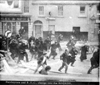 As the annual Apprentice Boys parade passed close to the Bogside area of Derry serious rioting erupted. The Royal Ulster Constabulary (RUC), using armoured cars and water cannons, entered the Bogside, in an attempt to end the rioting. The RUC were closely followed and supported by a loyalist crowd. The residents of the Bogside forced the police and the loyalists back out of the area. The RUC used CS gas to again enter the Bogside area. [This period of conflict between the RUC and Bogside (and Creggan) residents was to become known as the 'Battle of the Bogside' and lasted for two days. It also led to the errection of barricades with the area inside being called 'Free Derry'.]
Wednesday 13 August 1969
Serious rioting spread across Northern Ireland from Derry to other Catholic areas stretching the Royal Ulster Constabulary (RUC). The rioting deteriorated into sectarian conflict between Catholics and Protestants and many people, the majority being Catholics, were forced from their homes.
Jack Lynch, then Taoiseach (Irish Prime Minister), made a television address in which he announced that 'field hospitals' would be set up in border areas. He went on to say that: "... the present situation is the inevitable outcome of the policies pursued for decades by successive Stormont governments. It is clear also that the Irish government can no longer stand by and see innocent people injured and perhaps worse." [Lynch is often misquoted as having said: 'stand idly by'.]
[ August 1969; Partition; United Nations]
Thursday 14 August 1969
British Army Troops Deployed
After two days of continuous battle, and with the Royal Ulster Constabulary (RUC) exhausted, the Stormont government asked the British government for permission to allow British troops to be deployed on the streets of Northern Ireland. Late in the afternoon troops entered the centre of Derry.
John Gallagher, a Catholic civilian, was shot dead by the Ulster Special Constabulary ('B-Specials') during street disturbances on the Cathedral Road in Armagh. [John Gallagher was recorded, by the Royal Ulster Constabulary (RUC), as the first 'official' victim of 'the Troubles'.]
In Belfast vicious sectarian riots erupted and continued the following day. In Divis Street the RUC fired a number of shots, from a heavy Browning machine-gun mounted on an armoured car, into the Divis Flats and Towers. One of the shots killed a young Catholic boy while he lay in bed.

[ Political Developments; Law Order; Deployment of British Troops. ]
[ August 1969]
Friday 15 August 1969
Six People Killed
Six people were killed and many more injured during sectarian riots in Belfast. Many families were also forced to move from their homes. British troops took up duties on the streets of west Belfast. [Four killings by RUC officers were the subject of a Police Ombudsman's investigation report, published on 6 May 2021. The Ombudsman stated that, '... there was no effective police investigation into these deaths at the time.']
[ Political Developments; Law Order; Deployment of British Troops ]
[ August 1969; United Nations; USA]
Saturday 16 August 1969
[ August 1969; United Nations]
Sunday 17 August 1969
[ Political Developments; Law Order; Deployment of British Troops. ]
Monday 18 August 1969
[ August 1969; United Nations; Irish Republican Army (IRA)]
Tuesday 19 August 1969
 Representatives of the British and Northern Ireland governments held a meeting in London. A Communique and Declaration was issued at the end of the meeting. The declaration affirmed that there would be no change in the constitutional status of Northern Ireland without the consent of the Parliament of Northern Ireland. [This Joint Declaration became known as the 'Downing Street Declaration', a name which was applied to another document on 15 December 1993.]
Harold Wilson, then British Prime Minister, was interviewed about the meeting by ITV's News at Ten (see transcript). Wilson was also interviewed a short time later by BBC news programme Twenty-Four Hours (see transcript).
[ Political Developments; Law Order; Deployment of British Troops. ]
[ August 1969; television transcript; Irish Republican Army (IRA); Civil Rights]
Wednesday 20 August 1969
[ Political Developments; Law Order; Deployment of British Troops. ]
Thursday 21 August 1969
[ August 1969; United Nations; United Nations Observer; personal representative]
Friday 22 August 1969
[ August 1969]
Monday 25 August 1969
[ Civil Rights]
Tuesday 26 August 1969
The Hunt Committee was appointed to consider the structure of the Royal Ulster Constabulary (RUC) and the 'B-Specials' (Ulster Special Constabulary; USC).
[ August 1969; USA; Other Political Developments; Partition]
Wednesday 27 August 1969
James Callaghan, then British Home Secretary, visited Belfast and Derry for talks with the Unionist government and others. The Stormont government announced the establishment of an Inquiry, to be chaired by Justice Scarman, into the circumstances of the riots during the year.
[ Political Developments, Civil Rights Campaign. ]
Thursday 28 August 1969
Ian Freeland, then General Officer Commanding (GOC) of the British Army, became Director of Operations for security matters, thus effectively removing control of security from the Stormont government.
Friday 29 August 1969
Following the visit to Northern Ireland by James Callaghan, then British Home Secretary, a Communiqué on behalf of the Northern Ireland and British governments was released. This communiqué provided an outline of the work that would be undertaken on a number of further reforms mainly in the area of local government administration, housing, and employment.
[ Political Developments; Law Order. ]
Saturday 30 August 1969
A two-day 'Liberation Fleadh' cheoil was held in 'Free Derry'. ('Fleadh Cheoil' is Irish for a festival of music.) It was organised by Eamon McCann and Mary Holland and was held on the weekend of 30 and 31 August 1969. Many well known Irish musicans came to Derry to take part, including, The Dubliners, Tommy Makem, Armagh Pipers Club, etc. (See: Video about the event on YouTube.)
n.d. August 1969
[ IRA Statement; Deployment of British Troops. ]
n.d. August 1969
[ Political Developments; Law Order; Deployment of British Troops. ]
September 1969
Monday 1 September 1969
[ ]
Tuesday 2 September 1969
[ Other Political Developments; Partition]
Thursday 4 September 1969
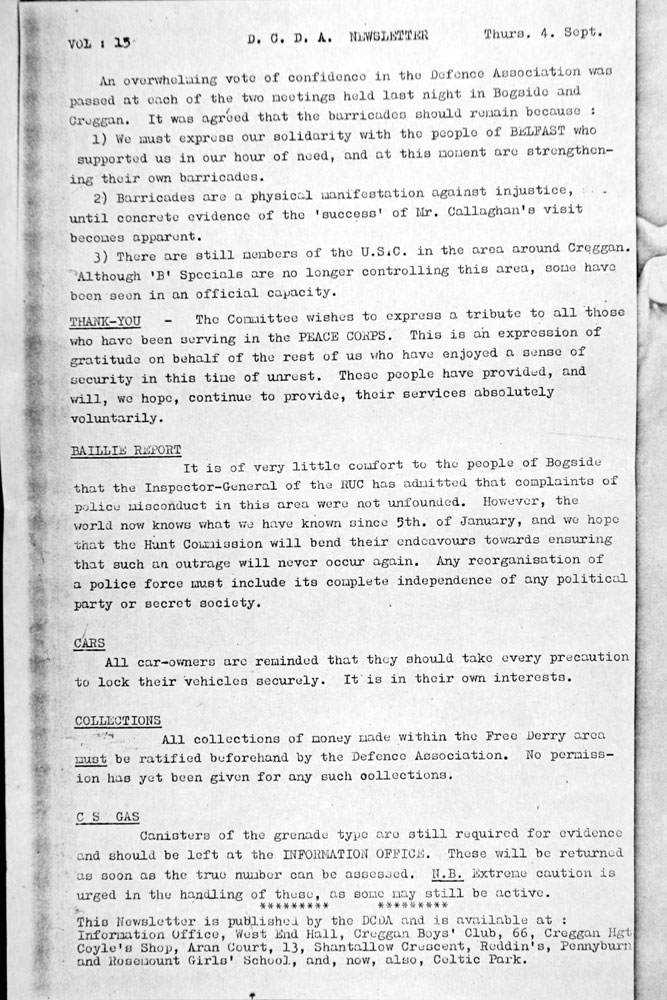
The Derry Citizens' Defence Association (DCDA) published an edition of its 'Newsletter' (Vol.15). [Informal publications such as this were used by various groups at various times to inform their supporters of developments.]
Friday 5 September 1969
[ August 1969; intelligence reports; United Nations]
Monday 8 September 1969
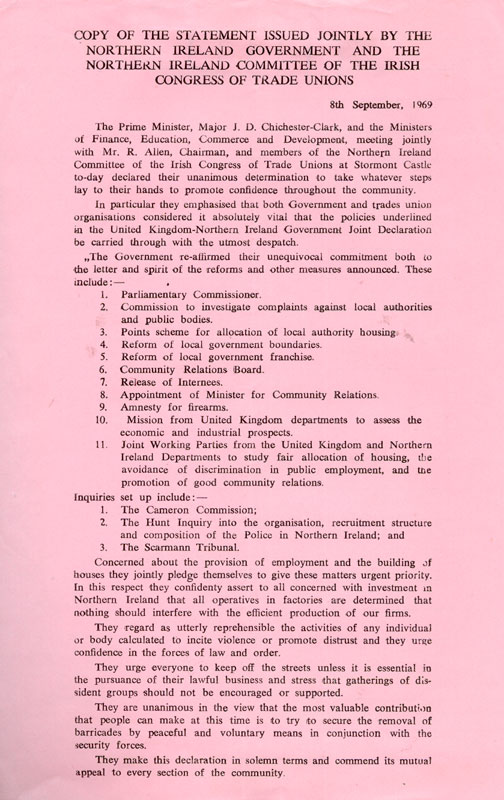
Members of the Northern Ireland Government held a meeting with the Northern Ireland Committee of the Irish Congress of Trade Unions at Stormont. A joint statement was issued following the meeting.
A man was shot dead in Belfast.
[ Political Developments; Law Order. ]
Tuesday 9 September 1969
'Peace Line' Constructed
Chichester-Clark, then Northern Ireland Prime Minister, announced that the British Army would erect a temporary 'peace-line' between Catholic and Protestant areas of Belfast to try to prevent rioting. [This temporary structure was replaced over the years by a more substantial 'peace wall' that still remains in place.]
[ Political Developments; Law Order; Deployment of British Troops. ]
Wednesday 10 September 1969
A 'peace line' was completed by the British Army in areas of Belfast. The 'no-go' areas in Derry and Belfast were recognised.
[ August 1969]
Thursday 11 September 1969
[ August 1969]
Friday 12 September 1969
Cameron Report Published
The Cameron Report (Cmd. 532) into disturbances in Northern Ireland was published. The Cameron Inquiry had been set up on 15 January 1969.
[ Political Developments; Civil Rights Campaign. ]
[ August 1969; United Nations; Other Political Developments]
Saturday 20 September 1969
Jack Lynch, then Taoiseach (Irish Prime Minister), gave a speech in Tralee, Republic of Ireland, entitiled 'The Situation in the Six Counties of North-East Ireland: the basis of our thinking and policy'.
Monday 22 September 1969
[ August 1969]
Saturday 27 September 1969
There was serious violence in parts of Belfast. Following a rally in the Ulster Hall a group of Loyalists began to attach Catholic homes in Coates Street, west Belfast. Petrol bombs were thrown over the Peace Line from Sackville Street. Five Catholic homes were destroyed by fire. Royal Ulster Constabulary (RUC) officers and British Army soldiers were present in the area but, apparently, were unable to prevent the attack. (This incident was said to have badly affected the confidence of the Catholic community in the British army.) When a loyalist crowd approached the Catholic Unity Flats, shots were fired into the crowd and at least one person was injured.
Sunday 28 September 1969
Violence continued in Belfast during the night. A Republican crowd attacked an RUC station in Hastings Street, Beflast. Two churches, one Catholic and one Protestant were also damaged in attacks.
Following the outbreak of violence over the weekend, it was announced that a further 700 British troops would be sent to Northern Ireland to reinforce the army presence in the region (bringing the overall deployment to 7,500).
[ September 1969; intelligence reports]
Tuesday 30 September 1969
A debate took place in Stormont on the Cameron Report which was published on 12 September 1969. A large protest of Loyalists, estimated at 5,000 people, took place outside the Stormont building. Some MPs reported being threatened and intimidated by individuals in the crowd.
October 1969
Friday 3 October 1969
[ Political Developments. ]
Thursday 9 October 1969
James Callaghan, then British Home Secretary, made a second visit to Northern Ireland between 9 and 10 October 1969. Following meetings between Callaghan and the Stormont government, plans for further reforms were agreed in a communiqué. The matters covered included: the establishment of a central housing authority; reforms to the Royal Ulster Constabulary (RUC) in light of the Hunt Report; reforms to the legal system; and the issue of fair employment.
Friday 10 October 1969
Hunt Report Published
The Hunt Report was published. The Report recommended that: the Royal Ulster Constabulary (RUC) should become an unarmed force; the Ulster Special Constabulary (USC; the 'B Specials') should be disbanded; a new RUC Reserve should be set up; and a new locally recruited part-time force should be established under the control of the British Army (BA) [this force was to become the Ulster Defence Regiment (UDR)].
Arthur Young was appointed as Chief Constable of the RUC at the request of Harold Wilson, then British Prime Minister. Young was appointed to oversee the reforms recommended in the Hunt Report. The publication of the report sparked serious rioting by loyalists in Belfast.
Saturday 11 October 1969
First RUC Officer Killed
Victor Arbuckle (aged 29), a member of the Royal Ulster Constabulary (RUC), was shot dead by Loyalists during street disturbances on the Shankill Road in Belfast. [Arbuckle was the first member of the RUC to be killed in 'the Troubles'.] Two Protestant civilians were shot dead by the British Army during rioting.
Sunday 19 October 1969
Loyalist Bomb
Thomas McDowell (45), a member of the Ulster Volunteer Force (UVF), was severely injured when a bomb he was planting exploded prematurely at a power station near Ballyshannon in County Donegal. [McDowell died from his injuries on 21 October 1969. McDowell was also a member of the Ulster Protestant Volunteers (UPV) a paramilitary style organisation formed by Ian Paisley (Holland, 1999: p23). See 30 March 1969.]
Tuesday 21 October 1969
Thomas McDowell (45), a member of the Ulster Volunteer Force (UVF), died from injuries he received when a bomb he was planting exploded prematurely at a power station near Ballyshannon, County Donegal, on 19 October 1969. [The UVF claimed responsibility for this bomb, and the one on 5 August 1969, in a statement issued on 24 October 1969.]
Friday 31 October 1969
Loyalist Bomb
The Ulster Volunteer Force (UVF)
exploded a bomb at the grave of Wolfe Tone in Bodenstown, Sallins, County Kildare, Republic of Ireland. The blast occurred at 5.00 am and destroyed a headstone. [The UVF claimed responsibility for this bomb in a statement issued on 1 November 1969.]
November 1969
Tuesday 11 November 1969
The act establishing a Ministry
for Community Relations was passed.
Friday 14 November 1969
[ Political Developments. ]
Tuesday 25 November 1969
The Commissioner for Complaints Act (Northern Ireland) became law. The act allowed for the establishment of a Commissioner to deal with complaints against local councils and public bodies.
The Electoral Law Act (Northern Ireland) became law. The main provision of the act was to make the franchise in local government elections in Northern Ireland the same as that in Britain.
Thursday 27 November 1969
A Commissioner for Complaints, John Benn, was appointed to deal with matters related to local government and public bodies.
Friday 21 November 1969
[ Other Political Developments; Partition]
Monday 24 November 1969
[ Other Political Developments; Partition]
Friday 28 November 1969
[ Other Political Developments]
n.d. November 1969
[ Law Order. ]
December 1969
Monday 1 December 1969
Patrick Corry (61) died four months after being struck with batons during an altercation with the Royal Ulster Constabulary (RUC) on 2 August 1969.
Monday 8 December 1969
[ Other Political Developments; Partition]
Wednesday 10 December 1969
[ Other Political Developments]
Thursday 18 December 1969
The Northern Ireland Police Authority (NIPA) was established. The Act to establish Ulster Defence Regiment (UDR) was passed.
Friday 26 December 1969
Loyalist Bomb
The Ulster Volunteer Force (UVF) exploded a bomb at the Daniel O'Connell monument at the southern end of O'Connell Street, Dublin, Republic of Ireland. The blast occurred at 4.30 am and the bomb was believed to be comprised of 10 pounds of gelignite and exploded behind one of the four winged figures at the foot of the monument. This part of the monument was damaged and windows in the street were shattered. [The UVF claimed responsibility for this bomb in a statement issued on 30 December 1969.]
Sunday 28 December 1969
Split in the IRA
There was a split in the Irish Republican Army (IRA). [The breakaway group became known as the Provisional IRA and the remaining group became known as the Official IRA. The split in the IRA became public knowledge on 11 January 1970.]
[ PRONI Records on CAIN - 1969 ]
[ NAI Records on CAIN - 1969 ]
Sources
This chronology has been compiled from a number of sources:
See Also:
- Material listed in the CAIN Bibliography which was published during 1969.
- For a full list of, and links to, on-line sources see the Guide to the Internet.
Notes
- Each entry contains information, where relevant, on the following topic areas:
- Major security incidents
- Political developments
- Policy initiatives
- Economic matters
- Other relevant items
- Information contained within square brackets [ ] may contain commentary or information that only became publicly available at a later date.
- Any piece of information which is followed by a question mark in parenthesis (?) is a best estimate while awaiting an update.
|